> ## Documentation Index
> Fetch the complete documentation index at: https://docs.jataka.io/llms.txt
> Use this file to discover all available pages before exploring further.
# Quick Start Guide
> Step-by-step onboarding guide for GitHub, Salesforce, API keys, CI setup, and Jira integration.
# Quick Start Guide
Use this guide to set up Jataka with GitHub, Salesforce, CI secrets, and Jira in a production-ready way.
 Connect your GitHub account from the Jataka dashboard.
Authorize repository access for the organization you want to onboard.
Connect your GitHub account from the Jataka dashboard.
Authorize repository access for the organization you want to onboard.
 Select the GitHub repository where your Salesforce metadata and workflows are maintained.
Confirm that the selected repository is the same one used for your release process.
Select the GitHub repository where your Salesforce metadata and workflows are maintained.
Confirm that the selected repository is the same one used for your release process.
 Select the target branch that should run Jataka checks.
If your workspace uses Brain profiles, choose the appropriate Brain for this repository.
Select the target branch that should run Jataka checks.
If your workspace uses Brain profiles, choose the appropriate Brain for this repository.
 Connect Salesforce and choose the correct environment: production (`login.salesforce.com`) or sandbox (`test.salesforce.com`).
Verify that the connected org matches the environment used by your deployment pipeline.
Connect Salesforce and choose the correct environment: production (`login.salesforce.com`) or sandbox (`test.salesforce.com`).
Verify that the connected org matches the environment used by your deployment pipeline.
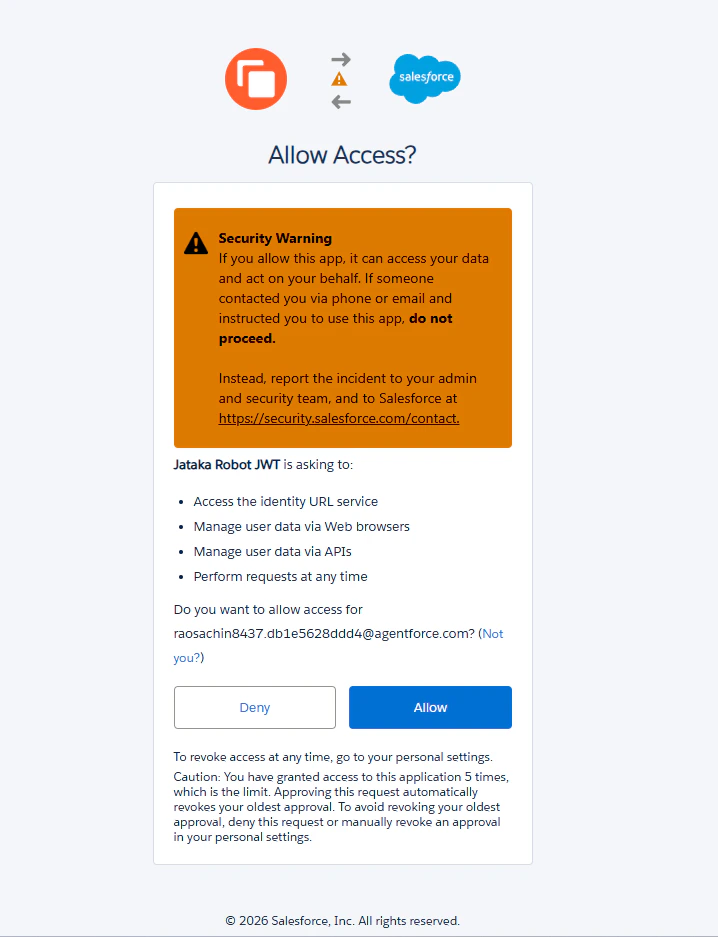 Allow all the permissions
 Authenticate your target Salesforce org in the CLI first:
```bash theme={null}
sf org login web --alias staging-org
```
Then display the org details and copy the generated SFDX auth URL:
```bash theme={null}
sf org display --target-org staging-org --verbose
```
Authenticate your target Salesforce org in the CLI first:
```bash theme={null}
sf org login web --alias staging-org
```
Then display the org details and copy the generated SFDX auth URL:
```bash theme={null}
sf org display --target-org staging-org --verbose
```
 **Optional:** Add the generated auth URL as a GitHub Actions secret as `SFDX_AUTH_URL`.
Add this to your workflow file to make sure changes are deployed the testing environment before running tests:
```yaml theme={null}
- name: Authenticate to Salesforce
run: |
echo "${{ secrets.SFDX_AUTH_URL }}" > auth_url.txt
sf org login sfdx-url --sfdx-url-file auth_url.txt --set-default --alias staging-org
rm auth_url.txt
```
**Optional:** Add the generated auth URL as a GitHub Actions secret as `SFDX_AUTH_URL`.
Add this to your workflow file to make sure changes are deployed the testing environment before running tests:
```yaml theme={null}
- name: Authenticate to Salesforce
run: |
echo "${{ secrets.SFDX_AUTH_URL }}" > auth_url.txt
sf org login sfdx-url --sfdx-url-file auth_url.txt --set-default --alias staging-org
rm auth_url.txt
```
 Generate the Jataka API key from the integration setup panel (Step 3 flow).
Save it in GitHub Secrets as `JATAKA_API_KEY` the same way as other credentials.
Generate the Jataka API key from the integration setup panel (Step 3 flow).
Save it in GitHub Secrets as `JATAKA_API_KEY` the same way as other credentials.
 Add this step to your project workflow file (for example, `.github/workflows/deploy.yml`) after Salesforce deployment:
```yaml theme={null}
- name: Trigger Jataka AI UI Tests
# Put this step AFTER your Salesforce deployment step (Gearset, Copado, or SFDX)
run: |
curl -X POST "${{ secrets.JATAKA_API_URL }}/api/integrations/github/trigger" \
-H "Authorization: Bearer ${{ secrets.JATAKA_API_KEY }}" \
-H "Content-Type: application/json" \
-d '{
"installation_id": "YOUR_INSTALLATION_ID",
"repo_full_name": "${{ github.repository }}",
"branch": "${{ github.head_ref || github.ref_name }}",
"pr_number": ${{ github.event.pull_request.number || 'null' }},
"test_mode": "${{ vars.JATAKA_TEST_MODE || 'auto' }}",
"action": "${{ github.event.action }}",
"before_sha": "${{ github.event.before }}"
}'
```
Create a GitHub Actions variable named `JATAKA_TEST_MODE` and set it based on your need under the actions -> variable.
Add this step to your project workflow file (for example, `.github/workflows/deploy.yml`) after Salesforce deployment:
```yaml theme={null}
- name: Trigger Jataka AI UI Tests
# Put this step AFTER your Salesforce deployment step (Gearset, Copado, or SFDX)
run: |
curl -X POST "${{ secrets.JATAKA_API_URL }}/api/integrations/github/trigger" \
-H "Authorization: Bearer ${{ secrets.JATAKA_API_KEY }}" \
-H "Content-Type: application/json" \
-d '{
"installation_id": "YOUR_INSTALLATION_ID",
"repo_full_name": "${{ github.repository }}",
"branch": "${{ github.head_ref || github.ref_name }}",
"pr_number": ${{ github.event.pull_request.number || 'null' }},
"test_mode": "${{ vars.JATAKA_TEST_MODE || 'auto' }}",
"action": "${{ github.event.action }}",
"before_sha": "${{ github.event.before }}"
}'
```
Create a GitHub Actions variable named `JATAKA_TEST_MODE` and set it based on your need under the actions -> variable.
 Connect your Jira account so Jataka can read ticket context tied to branches, commits, or pull requests.
Ensure the Jira site selected is the one used by your engineering teams.
Connect your Jira account so Jataka can read ticket context tied to branches, commits, or pull requests.
Ensure the Jira site selected is the one used by your engineering teams.
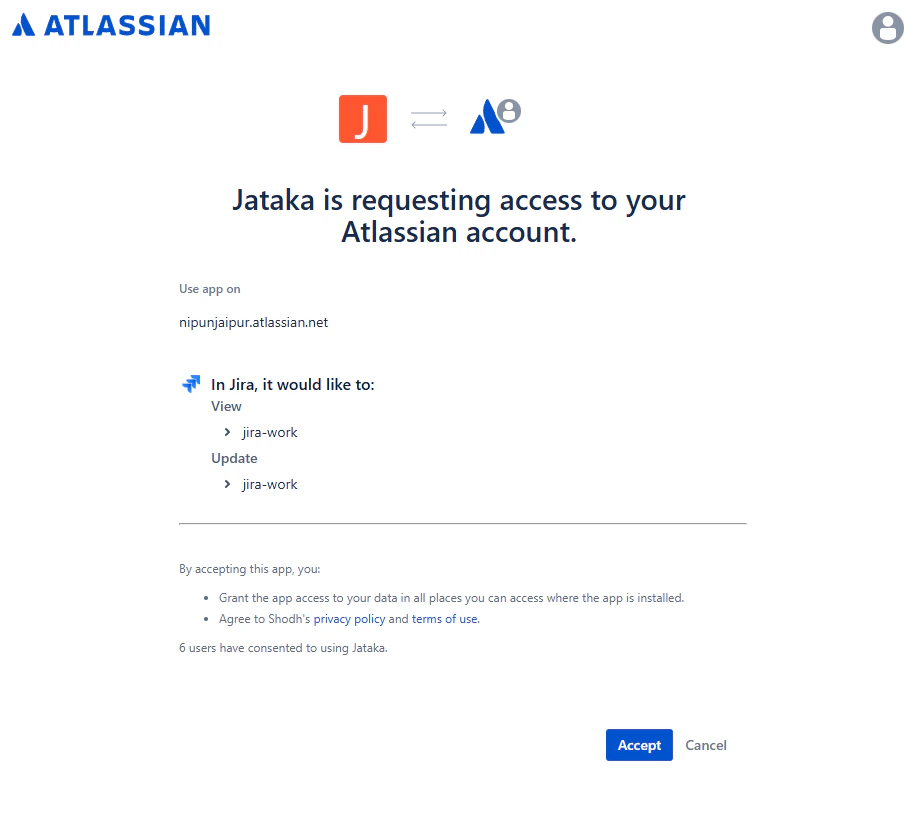 Allow all the permissions and click **Accept**.
 Set the exact Jira project key that should be used for ticket lookup.
Validate the key format and test one linked ticket before enabling for all pipelines.
Set the exact Jira project key that should be used for ticket lookup.
Validate the key format and test one linked ticket before enabling for all pipelines.
 Include the Jira ticket number in the pull request title so Jataka can derive ticket context for test execution.
Example format: `PROJ-123: Improve lead conversion validation`.
Setup complete: your repository, Salesforce org, secrets, workflow checks, and Jira context are now aligned for automated Jataka validation.
## MCP Server Setup (VS Code)
To use governed, context-aware coding directly in your IDE, install and authenticate the Jataka VS Code extension using your dashboard auth token.
Read the full setup and tool guide here: [MCP Server for VS Code](/mcp-server)
Include the Jira ticket number in the pull request title so Jataka can derive ticket context for test execution.
Example format: `PROJ-123: Improve lead conversion validation`.
Setup complete: your repository, Salesforce org, secrets, workflow checks, and Jira context are now aligned for automated Jataka validation.
## MCP Server Setup (VS Code)
To use governed, context-aware coding directly in your IDE, install and authenticate the Jataka VS Code extension using your dashboard auth token.
Read the full setup and tool guide here: [MCP Server for VS Code](/mcp-server)